1. When care begins in simple places
In Pointe-Noire, Congo Brazzaville, many people live with very limited resources. When health problems appear, going to the hospital is not always easy. Some people do not have enough money, some lack transportation, and others live in areas where the roads become muddy and difficult to travel, especially during the rainy season.
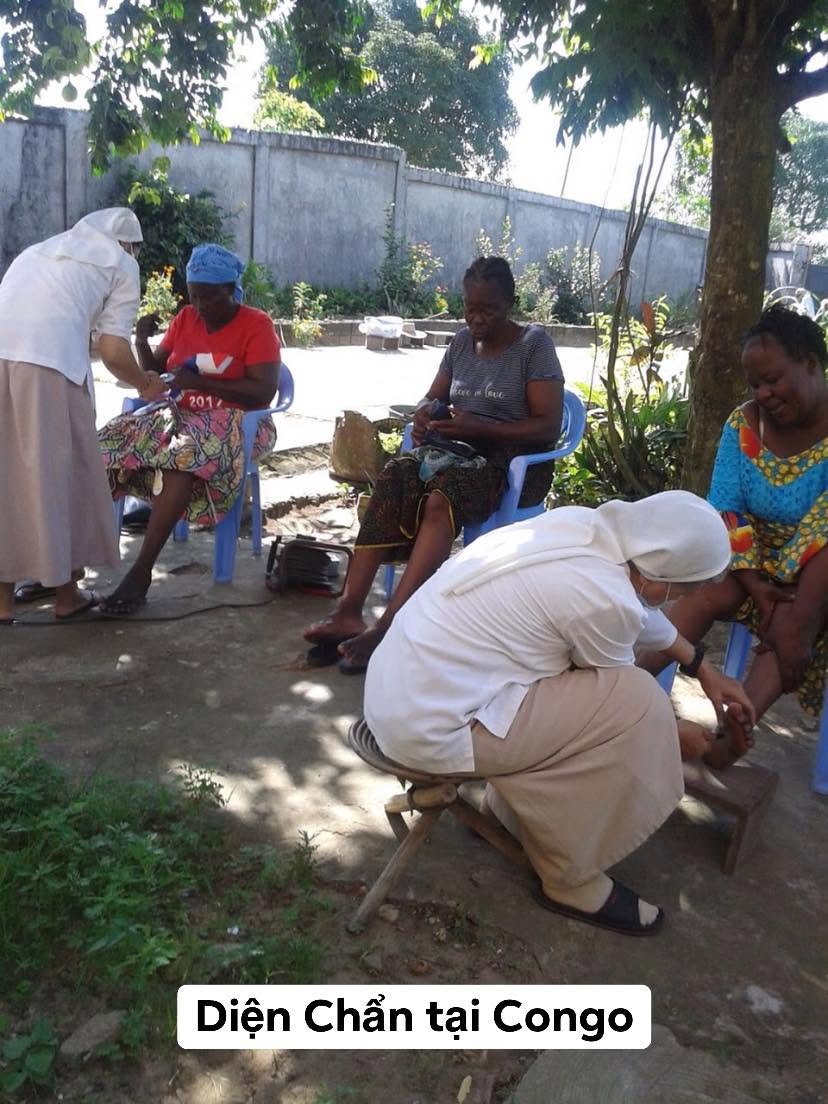
That is why care sometimes begins in the simplest places: a corner of a corridor, a small courtyard, or under the shade of a tree in the garden.
There, the sisters listen to local people, observe their bodies, and support them with the methods they have learned. Sister Thu Hồng, from the Congregation of the Handmaids of the Blessed Sacrament, attended the expanded Dien Chan Course in December 2021. While serving the local community in Congo, she shared that the sisters combined Dien Chan with foot reflexology to care for the people.
2. Dien Chan expands the foundation of foot reflexology
After learning more about Dien Chan, she said:
“Now that I know Dien Chan, I will use the Dien Chan method.”
This statement does not suggest that Dien Chan replaces foot reflexology. Rather, it shows how Dien Chan can expand an existing foundation of care: from the feet to the face, ears, hands, and many other reflex zones of the body.
For those already familiar with foot reflexology, Dien Chan can be seen as an additional language — offering more ways to observe, more tools to practice with, and greater flexibility when caring for a community. Many students who come to Dien Chan are already foot reflexology practitioners, bodywork professionals, or natural health caregivers.
3. A simple method close to community life
Dien Chan is a proactive self-care method created in Vietnam by Professor Bùi Quốc Châu in 1980.
What makes this method special is its accessibility: practitioners can begin with their own hands, a detector tool, a small Dien Chan hammer, a little warming balm, or very simple tools from everyday life.
In Congo, the value of Dien Chan is not found in complexity. Its value lies in its ability to enter daily life — where a sister can sit beside a local person and use what she has learned to support them with devotion and simple means.
From Vietnam to Congo, Dien Chan becomes a small bridge — bringing self-care knowledge closer to families, communities, and places where access to medical resources remains limited.
Because sometimes, a simple method can open the door to a great deal of hope.
Dinh Huong Thao
Health Educator & Dien Chan MultiReflexology Educator
Self-Healing & Health Education Platform